Zodiac sign dates and cusps: why your sign can switch on the 19th–23rd
You were born on 22 November. One zodiac chart says Sagittarius, another says Scorpio, and both are quoting a printed table. A sign does not begin on a calendar day: it begins at the exact moment the Sun crosses a line in the sky, and that moment lands on a different clock time every year.
Nobody in that argument is lying. The table is simply too coarse for the days between the 18th and the 23rd of a month. Here is what fixes a sign date, why it drifts, and how to settle your own birthday with the zodiac chart and sign finder or with a pencil and a time-zone map.
What a zodiac sign date really marks
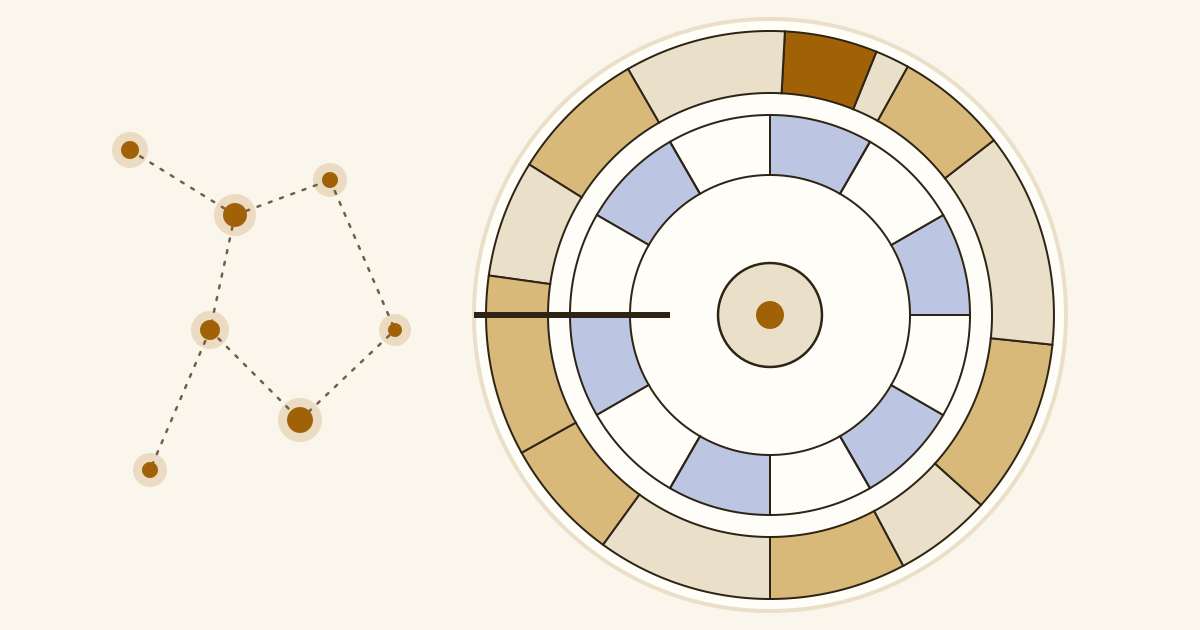
In the tropical zodiac that Western astrology uses, a sign is a 30° slice of the ecliptic, the Sun's yearly path, counted from the March equinox point, which is 0° Aries. The astrological sign table on Wikipedia lists the twelve slices with their longitudes. The Sun covers the full 360° in one tropical year of 365.2422 days, so it spends roughly a month in each slice.
"Roughly" is doing real work. Earth's orbit is slightly oval, so the Sun seems to move faster in northern winter and slower in northern summer. In my solar model it stays in Capricorn for about 29.4 days and in Cancer for about 31.5. A sign boundary is therefore an instant, called an ingress, and not a date. The calendar date is only the day on which that instant falls in one particular time zone.
Why the switch moment drifts from year to year
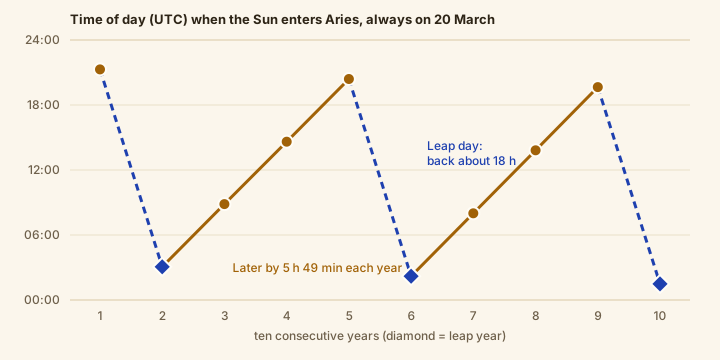
The calendar year has 365 days and the tropical year has 365.2422, so in an ordinary year the Sun reaches the same point 0.2422 days later: 5 hours 49 minutes further along the clock. A leap day then pushes the calendar forward by 24 hours, which drags the moment back by about 18. The result is a four-year sawtooth.
| Date and time | Note |
|---|---|
| 2024-03-20 03:04 | start of the run |
| 2025-03-20 08:50 | 5 h 46 min later |
| 2026-03-20 14:37 | 5 h 47 min later |
| 2027-03-20 20:24 | 5 h 47 min later |
| 2028-03-20 02:12 | after a leap day: 18 h 12 min earlier |
Over a long run the Gregorian calendar keeps this in check by skipping a leap day in most century years, so Aries starts on 19, 20 or 21 March and nearly always on the 20th. In a span of 101 consecutive years the Sun entered Aries on 19 March in 2 years, on 20 March in 77 and on 21 March in 22, counting UTC dates. A table that prints "Aries starts 21 March" matches the sky in 22 of those 101 years.
Start dates for all twelve signs, with the spread
This is the table I would want printed next to every zodiac chart. The counts in brackets say in how many of the 101 years the Sun entered the sign on that UTC date. I computed them with the Meeus low-precision solar formula, good to about 15 minutes.
| Sign | Start date (years out of 101) | Most common | Sun stays (days) |
|---|---|---|---|
| ♈︎ Aries | Mar 19 (2), Mar 20 (77), Mar 21 (22) | Mar 20 | 30.5 |
| ♉︎ Taurus | Apr 19 (36), Apr 20 (65) | Apr 20 | 31.0 |
| ♊︎ Gemini | May 20 (40), May 21 (61) | May 21 | 31.3 |
| ♋︎ Cancer | Jun 20 (14), Jun 21 (80), Jun 22 (7) | Jun 21 | 31.5 |
| ♌︎ Leo | Jul 22 (61), Jul 23 (40) | Jul 22 | 31.3 |
| ♍︎ Virgo | Aug 22 (32), Aug 23 (69) | Aug 23 | 30.9 |
| ♎︎ Libra | Sep 22 (41), Sep 23 (60) | Sep 23 | 30.4 |
| ♏︎ Scorpio | Oct 22 (10), Oct 23 (83), Oct 24 (8) | Oct 23 | 29.9 |
| ♐︎ Sagittarius | Nov 21 (16), Nov 22 (80), Nov 23 (5) | Nov 22 | 29.6 |
| ♑︎ Capricorn | Dec 21 (57), Dec 22 (44) | Dec 21 | 29.4 |
| ♒︎ Aquarius | Jan 19 (16), Jan 20 (81), Jan 21 (4) | Jan 20 | 29.6 |
| ♓︎ Pisces | Feb 18 (53), Feb 19 (48) | Feb 18 | 30.0 |
Read the middle column as the honest cusp zone. If your birthday appears in a sign's list of start dates, or is the day before one, the year and the hour decide, not the table.
Time zones can move the date a second time
The times above are UTC, and a sign changes at the same instant everywhere on Earth. What differs is the clock on the wall. An ingress at 16:00 UTC is 03:00 the next morning in Sydney in summer and 08:00 the same morning in Los Angeles in winter. A table made in Australia and one made in California can print different start dates for the very same instant, and both are correct for their readers.
| Birth data | In UTC | When the Sun switched | Result |
|---|---|---|---|
| 1985-03-20 22:00, London (GMT) | 1985-03-20 22:00 | Aries began 1985-03-20 16:15 UTC | Aries, Sun at 0°14' |
| 1978-11-22 08:15, Sydney (UTC+11) | 1978-11-21 21:15 | Sagittarius began 1978-11-22 16:00 UTC, which is 03:00 on 23 November in Sydney | Scorpio, Sun at 29°12' |
| 1990-02-18, New York (UTC−5), time unknown | — | Pisces began 1990-02-18 22:06 UTC, which is 17:06 in New York | Aquarius until 17:06, Pisces after |
The Sydney row is the one that surprises people. The birth certificate says 22 November, a fixed table says Sagittarius from the 22nd, and yet the Sun was still in Scorpio for another 18 hours and 45 minutes when that baby was born. The London row is the mirror image: a table that ends Pisces on 20 March misses a baby born in the evening, nearly six hours after the Sun entered Aries.
How to settle your own cusp birthday
- Take the clock time and the place from the birth record, and find out whether daylight saving time was in force that day.
- Subtract the zone's offset to get UTC. New York in winter is UTC−5, so 17:06 local is 22:06 UTC; in summer it is UTC−4.
- Look up the Sun's ingress into the relevant sign for that year, in UTC, to the minute.
- Compare the two moments. Earlier than the ingress means the previous sign; later means the new one.
- If they are within about 30 minutes, call it undecided. My own calculation is good to roughly 15 minutes, and a birth time rounded to the nearest quarter hour cannot settle it either. Check a published ephemeris and the record itself.
With no birth time on a cusp day, the only correct answer is both signs plus the switch moment in your zone, which is what the sign finder gives you. On any date it also shows the start and end of your sign for that year, and it warns you when the popular fixed tables would have put you in the neighbouring sign. When the birth falls within half an hour of the ingress it says so plainly and keeps both signs open. For births long ago, check what the clocks really showed in that place; time-zone rules have changed repeatedly and local records sometimes used a local mean time.
What "born on the cusp" does and does not mean
At every instant the Sun is in exactly one sign, so there is no blended "cusp sign". The phrase is popular shorthand for a birthday within a day or two of a boundary. The Sun moves about 1° a day, so "within 2° of the edge" means two days. Some astrologers read a Sun that close to an edge as colouring the neighbouring sign, and the named cusps you meet online ("cusp of …") belong to modern popular astrology rather than to the traditional technique. My rule: your sign is the one the Sun was in, and the neighbour is a footnote if you enjoy it, never a replacement. In technical astrology "cusp" also means the start of a house, which is a different thing.
The birth time matters far more for the faster-moving points. The Moon changes sign every two to three days, and the Ascendant changes sign about every two hours. For the Sun's sign alone, the time only matters on the one or two days around each ingress.
Questions and answers
What zodiac sign is 20 March?
It depends on the year and the hour. Across 101 years the Sun entered Aries on 19 March in 2, on 20 March in 77 and on 21 March in 22 (UTC dates), so 20 March is split between Pisces and Aries in most years and is all Pisces in the years when the switch falls on the 21st.
Why do two websites give different dates for the same sign?
Each prints one fixed date, but the Sun's entry moves by about six hours a year and by a day depending on the time zone. A fixed table is a convenient average, not a measurement.
Is there a separate cusp sign?
No. The Sun is in one sign at any instant. Cusp is popular shorthand for being born within a day or two of the switch, and the sign still depends on the exact moment.
Do sign dates differ in the southern hemisphere?
No. Signs are anchored to the March equinox, not to the seasons, so Aries starts on the same instant everywhere even though it is autumn there.