Tropical vs sidereal zodiac and Ophiuchus: did your sign change?
Your sign did not change. The headlines about a thirteenth sign called Ophiuchus, and about a "shifted" zodiac, mix up two things that share twelve names: the star patterns on the sky, and the twelve equal 30° sectors that Western astrology measures from the March equinox. The two drifted apart long ago, and the people who built both systems know it.
A sidereal astrologer may tell you that you are "really" the sign before the one you grew up with, and a tropical astrologer will say you are not. Both are right inside their own system. What follows explains the gap, shows how far apart the two zodiacs sit today, says where Ophiuchus fits (it does not) and gives you a way to tell which zodiac any page is using.
A sign is not a constellation
A sign is a 30° slice of the ecliptic, the Sun's yearly path, counted from the March equinox point, which is 0° Aries. The astrological sign table on Wikipedia explains the tropical and the sidereal definitions. A constellation is a star pattern whose borders astronomers have drawn, and they are not equal. The Sun passes in front of thirteen of them along the ecliptic, and for very different lengths of time: roughly six weeks for Virgo, about eighteen days for Ophiuchus and about a week for Scorpius.
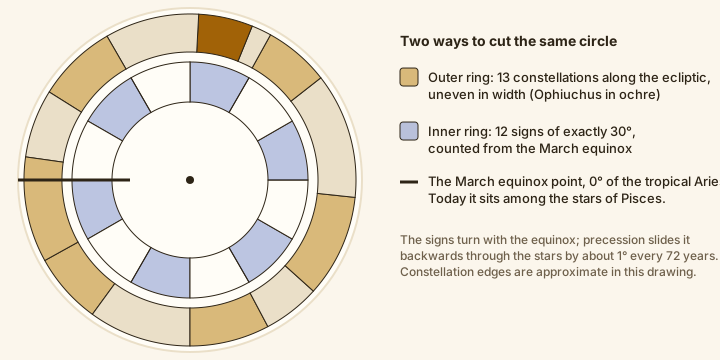
The twelve names overlap because the signs were named after the constellations they once sat in front of. Naming is where the resemblance ends. The twelve-fold division is a measuring scheme, and measuring schemes do not need to match the star shapes they were named for.
Precession: why the two drift apart
Earth's axis wobbles like a spinning top, one full turn in about 25,800 years. As it wobbles, the March equinox point slides backwards along the ecliptic by about 50 arcseconds a year, which is about 1° every 72 years. The tropical zodiac is fixed to the equinox, so it slides with it. The stars do not.
Today the gap between the two is about 24°, nearly a whole sign. When the Sun reaches 0° tropical Aries on 20 March, it is in front of the stars of Pisces. Counting back at 72 years a degree, the two zodiacs lined up roughly seventeen centuries ago. The drift is slow but never stops: every 72 years the gap grows by another degree.
Tropical and sidereal, side by side
| Tropical | Sidereal | |
|---|---|---|
| Zero point | March equinox | A fixed point among the stars |
| Tied to | The seasons | The stars |
| Used by | Western astrology | Hindu (Vedic) astrology and some Western astrologers |
| Signs | 12, each 30° | 12, each 30° |
| Offset | none | about 24° behind, called the ayanamsa |
| Sun enters Aries | about 20 March | about 14 April |
| Ophiuchus | not a sign | not a sign |
The offset is the quantity that matters, and schools differ on its exact value by fractions of a degree. The most widely used setting in India is the Lahiri ayanamsa. For a quick conversion I use a round 24° and subtract it from the tropical longitude. The consequence is simple: a Sun in the first 24 or so degrees of a tropical sign is in the previous sidereal sign, and only the last 6 or so degrees stay in the same sign.
A worked case: a Sun at 16°56' of tropical Leo (where it stands around 10 August) becomes 16°56' minus 24°, or 22°56' of sidereal Cancer. So a Western Leo born around 10 August is a Cancer to a sidereal astrologer. A Western Leo born in the last days of the sign, roughly 17 to 22 August, stays Leo. With the Sun covering about 1° a day, "the first 24 degrees" means roughly the first 25 days of each tropical sign.
Ophiuchus, the thirteenth sign that is not one
The Sun does pass through the constellation Ophiuchus for about 18 days from late November to mid-December, and astronomers have known it for a long time. Every few years a headline announces that a new sign has been "added" and that everyone's sign has moved. Nothing of the kind happened, because astrological signs were never the constellations. No new sign entered astrology, and no table changed.
Even sidereal astrology, which does follow the stars' position, keeps twelve equal signs and does not insert a thirteenth. Thirteen-sign systems exist as modern proposals, but neither tradition uses them, and they would give yet another set of dates. If you simply want to know which constellation was behind the Sun at your birth, that is an astronomy question with an answer, and it has no bearing on your sign in either tradition.
How to tell which zodiac a page is using
- Find the Aries start date. About 20 or 21 March means tropical; about 13 or 14 April means sidereal.
- Look for the vocabulary. "Sayana" means tropical. "Nirayana", "ayanamsa", "Lahiri", "sidereal" and "Vedic" point to the sidereal zodiac.
- In software, find the setting for zodiac type and ayanamsa. If there is none, it is almost certainly tropical.
- Compare with a sign you know. If a site puts you one sign earlier than the one you were told all your life, it is sidereal. If it is off by a day, you are looking at a cusp problem and the guide to sign dates and cusps will settle it.
- Pick one zodiac and keep to it. Mixing the two inside one reading, such as a tropical Sun sign with sidereal houses, is where muddled readings start.
Which one should you use?
My view is that neither is more "real", because both are conventions for dividing the same circle. Western astrology chose the equinox so that the signs follow the seasons, and that choice goes back to Ptolemy. Indian astrology chose the stars so that the signs follow the sky behind them. What matters is that you do not blend the two. The zodiac chart on this site is tropical, so its sign dates and planet positions are the Western ones; the grouping of those signs into elements and modalities is covered in the elements and modalities guide.
Questions and answers
Did my zodiac sign change because of precession?
No. Precession moves the stars against the equinox, not your sign. Tropical astrology fixes signs to the equinox, so your tropical sign is the same as it always was; a sidereal sign differs by about 24°, which usually means the previous sign.
Is Ophiuchus a real zodiac sign?
Not in Western or Hindu astrology. The Sun passes in front of the constellation Ophiuchus for about 18 days, but the signs are twelve equal 30° sectors, and neither the tropical nor the sidereal tradition uses a thirteenth.
Which zodiac do Western astrologers use?
The tropical zodiac, which starts at the March equinox. Some Western astrologers use the sidereal zodiac, but most horoscopes and birth charts in the West are tropical.
Why is my Vedic sign different from my Western sign?
Vedic astrology uses the sidereal zodiac, which sits about 24° behind the tropical one. A Sun in the first 24 or so degrees of a tropical sign falls in the previous sidereal sign.