Elements and modalities: the 4x3 grid that organises the twelve signs
Every zodiac sign carries two group labels besides its name, and the twelve signs use all twelve possible pairings exactly once. Four elements times three modalities makes twelve, and once you see that, a zodiac chart stops being a list to memorise and becomes a grid you can rebuild from memory.
I teach beginners the grid before any keywords, because most of what is said about a sign is a mix of its element (what it is made of) and its modality (how it behaves). The pairings are also how the wheel's geometry works. The interactive wheel can colour the signs by element, modality or polarity, and the 12×12 relationship grid names the distance between every pair and says which of these labels they share. This guide explains what you are looking at.
The 4×3 grid that holds all twelve signs
| Element | Polarity | Cardinal | Fixed | Mutable |
|---|---|---|---|---|
| Fire | positive | Aries | Leo | Sagittarius |
| Earth | negative | Capricorn | Taurus | Virgo |
| Air | positive | Libra | Aquarius | Gemini |
| Water | negative | Cancer | Scorpio | Pisces |
The pattern is easy to rebuild. Number the signs from Aries as 0 to 11. The element repeats every four signs (fire, earth, air, water), the modality every three (cardinal, fixed, mutable), and the polarity every two. Because 4 and 3 share no common factor, no pairing is repeated before all twelve have been used. That is why the zodiac is a 4×3 grid and not some other shape. The element and modality names follow the sign table on Wikipedia, which is the reference I check against.
The four elements: what each sign is made of
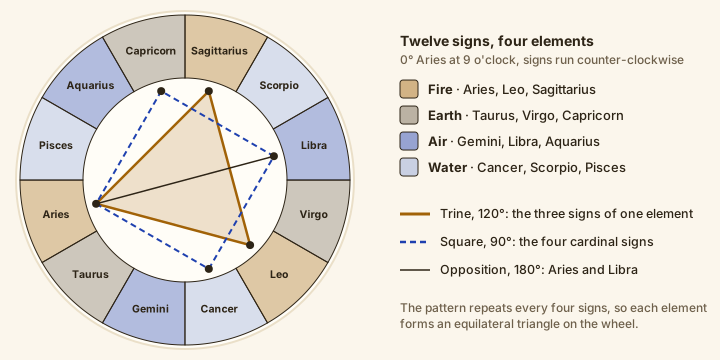
- Fire (Aries, Leo, Sagittarius): hot and dry in the classical scheme. Drive, display and enthusiasm; the signs that act on impulse.
- Earth (Taurus, Virgo, Capricorn): cold and dry. Things you can touch, count and maintain; the practical signs.
- Air (Gemini, Libra, Aquarius): hot and moist. Ideas, talk and relationships between things; the signs that connect.
- Water (Cancer, Scorpio, Pisces): cold and moist. Feeling, memory and attachment; the signs that absorb.
Fire and air are called positive (also masculine or yang), earth and water negative (feminine or yin). Those labels describe direction of energy in the old vocabulary, not men and women, and I prefer positive and negative for that reason. Polarity alternates sign by sign: Aries positive, Taurus negative, Gemini positive, and so on around the wheel.
The three modalities: how each sign behaves
Modality ties the signs to the year. The Sun enters a cardinal sign at an equinox or a solstice, so cardinal signs open a season. The fixed sign is the middle of the season, when it is fully in force. The mutable sign is the last stretch, when the season turns into the next.
| Season | Cardinal (begins) | Fixed (middle) | Mutable (ends) |
|---|---|---|---|
| Spring | Aries | Taurus | Gemini |
| Summer | Cancer | Leo | Virgo |
| Autumn | Libra | Scorpio | Sagittarius |
| Winter | Capricorn | Aquarius | Pisces |
The seasons reverse in the southern hemisphere, but the signs do not follow them: they stay anchored to the equinox and solstice points, so Aries is cardinal everywhere. In plain terms, cardinal signs initiate, fixed signs sustain and mutable signs adapt. None of the three is better than the others; a chart needs all of them.
Twelve signs, twelve combinations
Put an element and a modality together and you get a short, usable summary of each sign. These are my one-line readings, offered as symbolism and not as a description of anyone.
| Sign | Combination | One-line reading |
|---|---|---|
| Aries | cardinal fire | starts things and acts first |
| Taurus | fixed earth | holds ground and keeps what it has built |
| Gemini | mutable air | gathers information and changes topic easily |
| Cancer | cardinal water | opens with care and protects what it feels for |
| Leo | fixed fire | steady, visible warmth that does not flicker |
| Virgo | mutable earth | refines, adjusts and improves the details |
| Libra | cardinal air | starts exchanges and weighs one thing against another |
| Scorpio | fixed water | deep, persistent feeling that stays put |
| Sagittarius | mutable fire | roving enthusiasm that adapts to new ground |
| Capricorn | cardinal earth | plans and builds structures |
| Aquarius | fixed air | holds to principles and ideas |
| Pisces | mutable water | porous, absorbing, boundaries dissolve |
What the distance between two signs shares
Two signs are always 0 to 6 steps apart round the wheel (the other direction gives the mirror). The arithmetic above predicts exactly what they share, which is the whole logic behind the aspects. I treat this as structure, not as a verdict on any pairing.
| Steps apart | Name | Same element | Same modality | Same polarity |
|---|---|---|---|---|
| 0 | conjunction | yes | yes | yes |
| 1 | semi-sextile | no | no | no |
| 2 | sextile | no | no | yes |
| 3 | square | no | yes | no |
| 4 | trine | yes | no | yes |
| 5 | quincunx | no | no | no |
| 6 | opposition | no | yes | yes |
Check it with signs: Aries and Leo are four apart and both fire, so a trine. Aries and Cancer are three apart and both cardinal, so a square. Gemini and Leo are two apart, air and fire, both positive: a sextile. Taurus and Sagittarius are five apart and share nothing, a quincunx. Fire with air and earth with water are the classical friendly pairs of elements. That is why opposite signs, six steps apart, are not strangers: they share modality and polarity and pair complementary elements.
| Pair | Modality | Elements |
|---|---|---|
| Aries and Libra | cardinal | fire and air |
| Taurus and Scorpio | fixed | earth and water |
| Gemini and Sagittarius | mutable | air and fire |
| Cancer and Capricorn | cardinal | water and earth |
| Leo and Aquarius | fixed | fire and air |
| Virgo and Pisces | mutable | earth and water |
Rulers: the traditional and the modern scheme
Each sign has a ruling planet. The traditional scheme uses only the seven visible planets. The Sun rules Leo and the Moon rules Cancer, and the other five each rule two signs, laid out symmetrically either side of that pair: Mercury, Venus, Mars, Jupiter and Saturn in the order of their distance from the Sun. Mercury rules Gemini and Virgo, Venus Taurus and Libra, Mars Aries and Scorpio, Jupiter Sagittarius and Pisces, Saturn Capricorn and Aquarius.
The modern scheme gives the three outer planets to the signs they were matched with: Pluto to Scorpio, Uranus to Aquarius and Neptune to Pisces. Nine signs have the same ruler in both schemes; only those three differ (Scorpio Mars or Pluto, Aquarius Saturn or Uranus, Pisces Jupiter or Neptune). Pick one scheme and keep to it within a reading.
A worked count on a real chart
Here is the balance count I run first on any chart, for a birth in New York on 15 June at 14:30 summer time. Tally the seven planets from the Sun to Saturn by element and modality.
| Planet | Sign and degree | Element | Modality |
|---|---|---|---|
| Sun | Gemini 24°23' | air | mutable |
| Moon | Pisces 18°56' | water | mutable |
| Mercury | Gemini 6°09' | air | mutable |
| Venus | Taurus 19°06' | earth | fixed |
| Mars | Aries 11°13' | fire | cardinal |
| Jupiter | Cancer 15°59' | water | cardinal |
| Saturn | Capricorn 23°56' | earth | cardinal |
The totals: fire 1, earth 2, air 2, water 2; cardinal 3, fixed 1, mutable 3. The element spread is nearly even, so no element dominates. The modality count is lopsided, with one fixed planet against three each of the others. A tradition-minded reader would say this chart finds it easier to start and to adjust than to hold a course. I treat that as a prompt for a question, not as a finding. Nothing here predicts events.
For the numbers behind the table, the guide to sign dates and cusps explains when the Sun changes sign, and tropical vs sidereal explains why some astrologers place the same planets in different signs.
Questions and answers
How many signs are in each element?
Three. Fire is Aries, Leo and Sagittarius; earth is Taurus, Virgo and Capricorn; air is Gemini, Libra and Aquarius; water is Cancer, Scorpio and Pisces.
What are cardinal, fixed and mutable signs?
They are the three modalities. Cardinal signs begin a season (Aries, Cancer, Libra, Capricorn), fixed signs sit in its middle (Taurus, Leo, Scorpio, Aquarius) and mutable signs close it (Gemini, Virgo, Sagittarius, Pisces).
Which sign is opposite mine?
The one six signs away, which shares your modality and polarity: Aries and Libra, Taurus and Scorpio, Gemini and Sagittarius, Cancer and Capricorn, Leo and Aquarius, Virgo and Pisces.
Why do Scorpio, Aquarius and Pisces have two rulers?
The traditional scheme used the seven visible planets, giving Mars, Saturn and Jupiter those signs. When Pluto, Uranus and Neptune were discovered, many astrologers assigned them to the same signs as modern rulers.